


Why has your e-liquid turned colour? The answer lies in the microscopic interaction between nicotine and air.
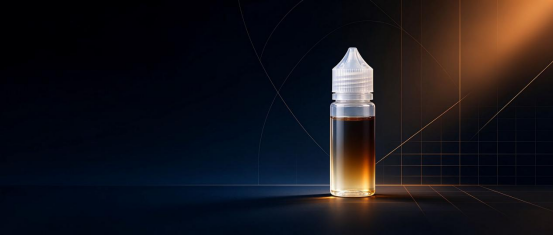
Colour change is essentially a slow chemical process between nicotine and air. It is common for e-liquid to darken over storage time, yet most users do not understand the underlying mechanism. Today, we dive into nicotine, the core ingredient of e-liquid, to break down the chemistry of e-liquid discolouration at the molecular level.
Nicotine is an alkaloid found in Solanaceae plants and the primary active component of tobacco. In its pure form, it is a colourless, transparent oily liquid with high volatility. Upon exposure to air, it readily oxidises and gradually turns yellowish-brown over time.
Therefore, it is nicotine oxidation itself, rather than flavourings or artificial colourants, that tints the e-liquid.
A nicotine molecule consists of two nitrogen-containing heterocycles: a six-membered pyridine ring and a five-membered pyrrolidine ring. The pyridine ring is structurally stable and aromatic, while the pyrrolidine ring is far more reactive and the primary target of oxidation.
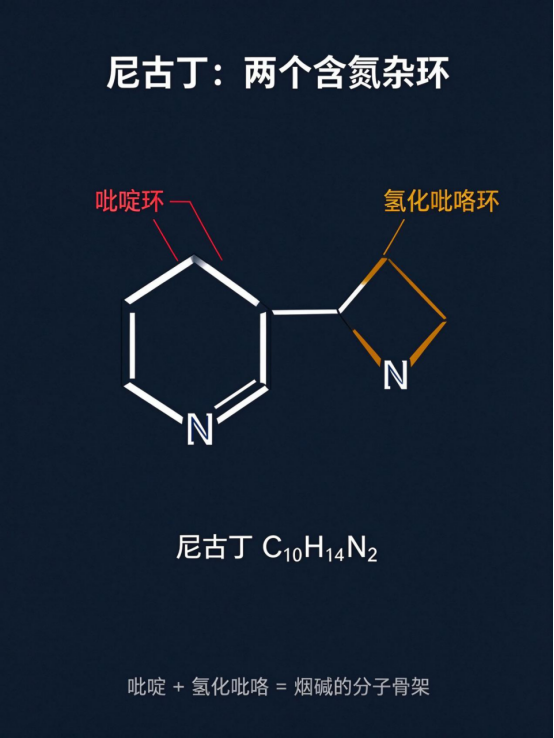
Nicotine is composed of two nitrogen-containing heterocycles: pyridine ring and pyrrolidine ring.
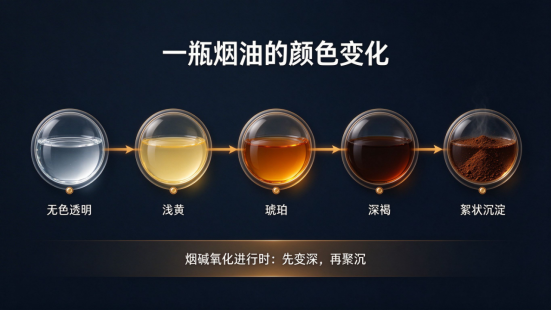
At room temperature, when these two rings interact with air, the reaction does not produce a single defined product. Instead, a series of intermediate compounds with chromophores are formed first. These compounds absorb visible light, causing the liquid to turn yellow and then darken further. As oxidation proceeds, these small molecules cross-link and polymerise, eventually forming flocculent precipitates.
Colour change is not a one-off reaction, but a continuous oxidation chain: progressive darkening followed by precipitation.
Under strong oxidising laboratory conditions, the pyrrolidine side ring of nicotine can be oxidised into a carboxyl group, yielding nicotinic acid (vitamin B3), while the aromatic pyridine ring remains intact.
This reaction only occurs under intense laboratory oxidation. It does not happen during normal storage or vaping. The claim that “vaping provides vitamin supplementation” is completely misleading. This reaction is mentioned merely to illustrate that the same molecule can follow different reaction pathways under different conditions — this also highlights why we need to properly understand discolouration.
Colour change is common and generally normal, but two scenarios must be distinguished:
Normal, no concern: Darkened colour with uniform texture, normal aroma, unchanged taste, and within shelf life.
Caution, recommended to discontinue use: Visible floccules, clumping or liquid stratification; rancid, burnt or pungent odour; obvious deterioration in flavour; expired product, or long-term exposure to high temperature and direct sunlight.
To judge whether an e-liquid is in good condition, do not rely on colour alone. Check its physical state, smell and taste.
Storage tip: Keep tightly sealed, away from light and heat.
Darker colour ≠ higher nicotine strength: Colour mainly reflects the degree of oxidation. It is also affected by flavour type, colourants and storage duration, and cannot be used as an indicator of nicotine concentration.
Discolouration ≠ complete nicotine degradation: Oxidation consumes part of the active nicotine but does not eliminate it entirely. We cannot conclude it is safer or more hazardous merely based on colour change.
The colour of e-liquid is a chemical trace left by the interaction between nicotine and air. Understanding discolouration helps us reliably tell natural ageing from genuine abnormal deterioration.
This article is for chemical ingredient education only. It makes no health guarantees and does not assess the efficacy of any product. Minors are prohibited from accessing e-cigarettes and e-liquid products.

Phone: +86-755-23502117
Email: marketing@ipurejuice.com


